
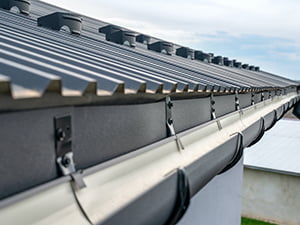
Roofs that drain at the eaves need gutters and downspouts positioned to carry rain and snowmelt to suitable discharge points. For a property owner in Kokomo, IN, choosing a gutter system comes down to a handful of factors: how much roof area drains into each run, how many downspouts are needed, what style and material fit the building, and how the system will handle local weather. Gingerich Guttering is a licensed, insured, family-owned company with more than 18 years protecting local homes and businesses, providing gutter services in the Kokomo area.
This guide walks through each factor and gives you a checklist of what to verify before you choose the next step. To discuss your property, call 765-434-1009.
When Picking Out a Gutter System, What Factors Should You Consider?

Several considerations go into a good choice. The table below summarizes the main ones and what to ask the installer about each.
| Factor | Why It Matters | What to Ask |
|---|---|---|
| Roof area | The larger the roof area draining into a run, the more water it must carry in a storm. | Ask how the roof area per run was used to choose the gutter size. |
| Downspout count and size | More roof area, valleys or long runs call for more or larger downspouts. | Ask why a particular number of downspouts was recommended. |
| Gutter profile | Half-round and K-style profiles are common in guttering generally. Ask which profiles Gingerich offers and what capacity each would provide for your roof. | Compare profiles on the same house, not only in a brochure. |
| Seamless or sectional aluminum | Seamless runs have joints mainly at corners and downspouts. Sectional runs have more joints but are easy to repair in sections. | Ask which fits your roofline and how the joints will be sealed. |
| Rain and snow | Heavy rain, snowmelt and ice put stress on gutters and hangers, so supports must be secure. | Ask how hangers are spaced and fastened. |
| Appearance and budget | The system is visible from the street, so appearance matters, and the scope affects the cost. | Ask for a site-specific proposal before deciding. |
Roof Area, Gutter Size and Downspouts
Gutter and downspout size follow from the roof. The effective roof area draining into each run is the starting point, because a large roof sheds a lot of water in a short time. A steeper pitch moves that water faster, and valleys can concentrate flow into one short stretch of gutter. A standard size applied to every property can leave some runs overwhelmed, so a site-specific recommendation is more reliable. During evaluation, ask how roof valleys, longer runs, and discharge locations affect the number of outlets and downspouts. Downspouts have a limited flow capacity as well, which means the number and size of downspouts should be matched to the runoff they must carry. The outlet location matters too: a downspout that empties onto a walkway or into a low spot may move a problem rather than solve it.
Profile, Material and Appearance
Gutters come in more than one profile, including half-round and K-style, and the selection should match both the building’s appearance and the flow capacity needed. Confirm the profiles available for your project rather than assuming every style is offered. Gingerich Guttering installs sectional and seamless aluminum gutters. Seamless aluminum gutters are formed to the length of each run, so there are joints mainly at corners and downspout connections. Because joints can loosen or leak over time, fewer of them may reduce potential leak points, but corners and downspout openings still need careful sealing. Sectional aluminum remains a workable option and is simpler to repair one section at a time. For more detail, see the seamless gutters Kokomo page.
Because gutters are visible from the street, appearance matters as well. Talk with the installer about how the system will look on your building, along with the budget for the scope of work.
Rain, Snow and Temperature Swings
Annual rainfall, snowmelt and temperature swings all affect how a gutter system performs. Heavy rain tests the capacity of the gutters and downspouts. Snow and ice add weight, which puts stress on hangers and fascia. For that reason, supports need to be fastened into solid material and spaced to carry a gutter that is full of water or snow. No gutter system is maintenance free, and aluminum gutters still collect debris and need periodic cleaning, especially near trees.
Drainage and Scope Checklist
Before you commit to a system, confirm that the plan covers each part of the drainage path:
- Joints and seams: how they will be sealed and how many there will be along each run.
- Supports: hanger type, spacing and what they will be fastened into.
- Downspouts: count, size and placement.
- Fascia condition: whether any boards need repair before new gutters go up.
- Discharge routing: where runoff will go based on grading, approved drainage outlets and access paths, without creating foundation pooling or slippery walkways.
- Maintenance access: how the system can be reached for cleaning, especially near trees.
Cleaning, Repair or Replacement
Choosing a system does not always mean starting over. If water overflows only because of a clog, cleaning may solve it. If a single seam, hanger or downspout section has failed, a localized repair can be enough, and the gutter repairs page explains which problems fit that approach. Full replacement fits best when problems appear along most of the run, when the system is undersized for the roof, or when fascia damage means the gutters can no longer be secured. For homes, the residential gutters page outlines installation, replacement, cleaning and repair, and for businesses the commercial gutters page does the same.
Closeout Checks After Installation
When the work is finished, confirm that the system does what it was meant to do:
- Water moves toward each downspout without standing in the run.
- Seams, corners and end caps are dry.
- Hangers are secure and downspouts are firmly attached.
- Discharge reaches the planned suitable outlet without pooling beside the foundation or crossing busy walkways.
Ask whether the installer can perform a controlled water-flow check safely before leaving. If not, observe from the ground at the next rainfall. Report any drip or overflow quickly so it can be corrected.
Gutter System in Kokomo, IN
If you are a property owner in Kokomo, IN, Gingerich Guttering can look at your roof and layout and discuss a system that fits. Contact us or call 765-434-1009 to get started.
Frequently Asked Questions
How is the size of a gutter system determined?
Size depends mainly on the roof area draining into each run, the roof pitch and the number of downspouts. A site-specific recommendation is more reliable than a standard size.
What is the difference between seamless and sectional aluminum gutters?
Seamless gutters are formed to the length of each run, so they have fewer joints. Sectional gutters come in pre-cut lengths joined along the run and can be repaired section by section.
Do weather and snow affect which system I should choose?
Yes. Heavy rain, snowmelt and ice affect capacity and put stress on hangers, so sizing and supports matter.
What should I check after a new system is installed?
Watch for water flowing to the downspouts, dry seams and corners, secure hangers and water reaching the planned drainage point without pooling at the building or across walkways.