
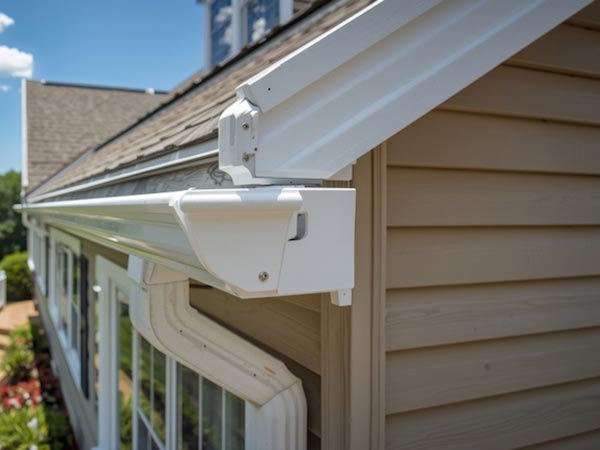
Fishers is home to a large number of two-story houses across planned neighborhoods, many with rooflines that vary in pitch and complexity from one property to the next. Understanding what happens during house gutter installation helps homeowners know what to expect and understand why each step matters to the performance of the finished system.
Call Gingerich Guttering at (765) 434-1009 for house gutter installation in Fishers, IN.
House Gutter Installation: Site Assessment and Sizing
Every installation begins with a site assessment, where a contractor walks the property to measure the roofline, note the pitch of each section, and identify how rainwater flows from the roof. On a two-story home, this assessment also accounts for added height and the way multiple roof sections often drain into shared areas, which affects how much water any single run needs to handle.
Gutter size and profile are determined based on this assessment rather than selected according to a one-size-fits-all standard. A larger roof area or steeper pitch increases the volume and speed of water reaching the gutter, often calling for a wider channel or larger downspouts to prevent overflow during heavy rain. Homes with complex rooflines, such as those with multiple gables or dormers common in many Fishers subdivisions, may need different sizing across sections of the same house.
How Seamless Gutters Are Fabricated On-Site
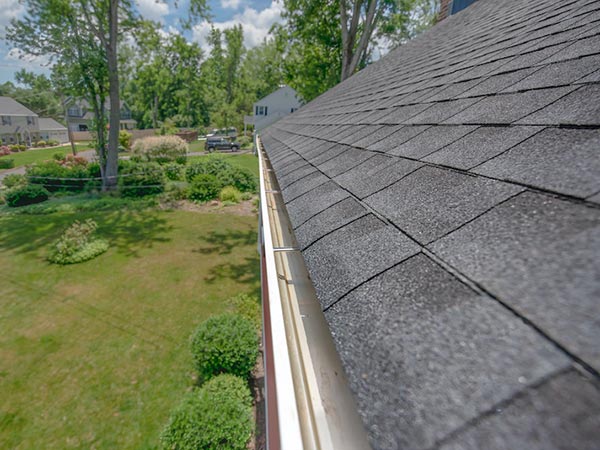
Seamless gutters are formed using a portable machine that shapes long, continuous lengths of material directly on the property, rather than joining together pre-cut sections. This on-site fabrication allows each run to match the exact length needed for a given roofline section, reducing the number of joints where leaks may develop over time. Because the material is shaped to order, a contractor can produce runs that fit around corners, changes in roofline height, or other features specific to a given house, which is particularly useful on two-story homes with varied architectural details.
Hanger Spacing, Pitch, and Downspout Placement
Hangers are the brackets that secure the gutter to the fascia board, and their spacing affects how well the system supports the weight of water, debris, and occasional ice. Closer spacing generally provides stronger support, particularly on longer runs or in areas prone to heavier snow accumulation.
Proper pitch is what allows water to flow toward the downspouts rather than sitting in the channel. Contractors typically build in a slight slope, calculated based on the specific length and layout of each section. Downspout placement follows from this pitch calculation, with downspouts positioned at the low points of each run and situated to direct water away from the foundation rather than concentrating it near the house.
What House Gutter Installation Means for Fishers Homeowners
Understanding each stage of house gutter installation, from the initial assessment through fabrication and final placement, helps homeowners see why a properly installed system costs more than a generic, prefabricated option. Each decision reflects the specific characteristics of the home.
For house gutter installation in Fishers, IN, contact Gingerich Guttering at (765) 434-1009 today.
FAQ
What gutter size is standard for a two-story home in Fishers, and when would a contractor recommend upsizing to handle a larger roof area or steeper pitch?
A standard five-inch profile works well for many two-story homes, but a contractor may recommend a wider six-inch profile when a roof section is unusually large, has a steep pitch, or drains multiple roof planes into a single run. Homes with attached garages or additions that expand total roof area are common candidates for upsizing.
Does house gutter installation require permits in Fishers or Hamilton County, and what should a homeowner confirm before work begins?
Standard residential gutter installation on an existing home typically does not require a separate permit in this area, though homeowners should confirm this with their contractor, particularly if the project involves structural changes to the fascia or roofline. It is worth confirming this with the installer before work is scheduled.
How do contractors determine the correct pitch for new gutters, and what happens to drainage performance if the pitch is even slightly off?
Contractors calculate pitch based on the length of each run and the location of the downspouts, aiming for a slope that is subtle enough to be visually unnoticeable while still sufficient to move water consistently toward drainage points. A gutter installed too flat allows water to pool and collect debris, while one pitched too steeply can rush water past a downspout opening before it has a chance to drain.