
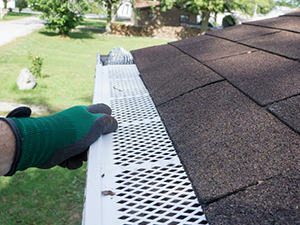
Every spring and every fall, the same chore shows up on the list. Climb the ladder, drag debris out of the gutters, flush the downspouts, hope nothing has rotted behind the fascia. Most Atlanta, Indiana property owners have done it so many times they have stopped questioning whether it has to be this way. It does not. Leaf protection installed by a qualified contractor eliminates the cleaning cycle and keeps your gutter system running the way it was designed to year-round. At Gingerich Guttering, we install leaf guard systems across Atlanta, IN, for property owners who are done putting up with a problem that has a permanent fix. Call us at (765) 434-1009 to find out what system best fits your home.
This article covers why twice-a-year gutter cleaning is a symptom of a solvable problem, what leaf protection systems actually do differently from unprotected gutters, and what Indiana property owners should know before choosing a system.
Leaf Protection Ends Gutter Cleaning Dread
The gutter cleaning routine has become so ingrained for Indiana homeowners that most people treat it like a fixed cost of property ownership. It is not. It is the predictable result of having gutters with no protection against the debris that Indiana’s tree canopy drops twice a year. Central Indiana has no shortage of oaks, maples, and sweet gums, and every one of them contributes to the layer of leaves, seed pods, and organic material that fills unprotected gutters by mid-November. When that debris sits wet through a rainy fall and a freezing winter, it does not just block drainage. It holds moisture against the gutter and the fascia behind it, accelerating deterioration and creating the conditions that shorten the life of the entire gutter system. Leaf protection breaks that cycle at the source.
What Happens to Unprotected Gutters Through an Indiana Fall
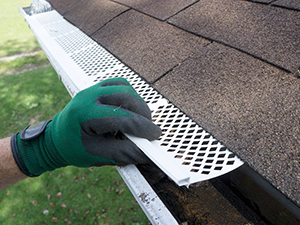
Indiana falls are as hard on gutters as they are beautiful. Leaves drop fast, rain comes often, and that mix of heavy debris and steady rainfall can clog a system in a matter of weeks. Once gutters are blocked, water has nowhere to go. It backs up under shingles, spills over the front edge and soaks the ground at the foundation, or slips behind the fascia where it sits out of sight.
The problem is that none of this shows up right away. It builds slowly. By the time it becomes visible, you are dealing with rotted wood, foundation issues, or interior damage. Those repairs add up quickly and often cost far more than installing proper leaf protection in the first place.
How Leaf Protection Systems Work?
Quality leaf guard systems allow water to enter the gutter while directing debris over the edge and off the roof. The mechanism varies by product type. Micro-mesh guards use fine stainless steel mesh that lets water through while blocking debris as small as shingle grit. Reverse curve systems use surface tension to pull water into the gutter while debris falls away. Solid cover designs with a nose-forward profile channel water in while shedding leaves. Each approach has strengths, and the right choice depends on the tree types on the property, roof pitch, and the gutter profile already in place. A contractor who installs only one system for every job is not matching the product to the property.
What to Watch Out For When Choosing Leaf Protection Systems
Not all leaf guard products perform equally, and the market has no shortage of options that look credible but fail within a season or two of Indiana weather. A few things worth evaluating before committing to a system:
- Material quality matters more than price point. Cheap plastic guards warp under summer heat and crack under winter ice, channeling water over the edge instead of into the gutter.
- Installation method determines performance under ice and snow load. Guards that clip loosely to the gutter lip can be displaced by ice damming, defeating the system entirely.
- Warranty coverage should address both product and installation. A material-only warranty leaves the property owner responsible for labor costs even when the product itself fails.
Does Leaf Protection Truly Eliminate Gutter Cleaning?
A quality leaf guard system installed correctly on a property with standard tree coverage eliminates routine gutter cleaning in most cases. Properties with heavy pine needle coverage may need an occasional debris rinse off the guard surface, but that is a different task than twice-yearly ladder climbs. For Atlanta, Indiana properties with typical deciduous canopy, a properly installed system turns gutters into something you stop thinking about rather than a recurring seasonal chore.
Leaf Protection in Atlanta, IN
If you are tired of the seasonal gutter cleaning routine, leaf protection installed by Gingerich Guttering is the fix that ends it. We install quality leaf guard systems across Atlanta, IN and the surrounding area with the product knowledge to match the right system to your property. Call us at (765) 434-1009 and let us put an end to the twice-a-year gutter dread for good.
FAQ
Can leaf protection be installed on existing gutters or does it require new gutter installation?
Most leaf guard systems can be installed on existing gutters in good condition, though gutters that are sagging, corroded, or improperly pitched should be corrected first.
How does leaf protection hold up under Indiana ice and snow?
Quality aluminum and stainless mesh systems handle Indiana winters well, though lower-grade plastic guards can warp or crack under freeze-thaw stress.
Will leaf protection work with all gutter profiles and sizes?
Most systems are available for standard 5-inch and 6-inch K-style gutters, and a contractor can confirm compatibility with your existing profile before installation.
Is leaf protection worth it on a property with only a few trees nearby?
Even light tree coverage contributes debris over time, and neighboring trees and wind-carried material affect gutters on properties without heavy canopy overhead.