
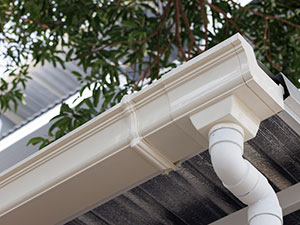
At Gingerich Guttering, we often work with building owners in Atlanta, Indiana who need reliable gutter installation for different roof types. From warehouses and office buildings to retail properties, the structure and slope of the roof have a major impact on how gutters are installed and how well they function. While homeowners can also benefit from understanding these factors, commercial properties often face larger-scale challenges like heavier water flow, snow load, and debris accumulation. For professional installation, contact Gingerich Guttering at (765) 434-1009.
How Roof Type Affects Gutter Installation
This article explains how different roof types affect gutter installation, what property owners should know about choosing the right system, and how proper installation can prevent water damage and reduce long-term maintenance. You’ll learn practical tips to keep gutters functioning efficiently no matter the size or style of the roof.
Sloped Roofs: Fast Water Flow
Sloped roofs are common on both commercial and residential buildings, but the scale on commercial properties often increases the challenges. Gutters need to be positioned carefully to handle fast-moving water and prevent overflow. The steeper the slope, the greater the volume of water reaching the gutter during heavy rainfall.
Key considerations for sloped roofs include:
- Correct gutter size: Larger gutters handle more water without overflowing.
- Proper downspout placement: Adequate spacing ensures water is efficiently directed away from the building.
- Secure mounting: Commercial roofs often require reinforced hangers to support the weight of water during storms.
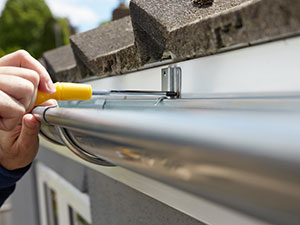
Flat Roofs: Managing Slow Drainage
Flat roofs, commonly seen on warehouses, retail buildings, and multi-story office buildings, present unique challenges for gutter installation. Water moves more slowly, which can lead to pooling if the gutters are not installed with precise slope and proper drainage outlets.
For flat roofs, professional installers often:
- Ensure slight pitch toward drains or downspouts
- Use larger capacity gutters to manage pooled water
- Check for roof membrane compatibility to prevent leaks
While homeowners less frequently have flat roofs, understanding these principles helps explain why commercial installations often require a higher level of expertise.
Multi-Level Roofs: Coordinating Water Flow
Commercial buildings with multi-level roofs require careful planning to prevent water from overflowing from higher sections onto lower roofs or walkways. Downspouts and gutters need to be strategically placed to handle intersecting rooflines and increased water volume.
Benefits of professional planning for multi-level roofs include:
- Minimized risk of water damage to walls, foundations, and lower roofs
- Less maintenance, as properly designed systems reduce debris accumulation
- Extended gutter lifespan, since each section is installed to handle load efficiently
Specialty Roofs: Curved or Metal Surfaces
Some commercial buildings feature curved, domed, or metal roofs. These surfaces create unusual water flow patterns that can overwhelm standard gutter systems. Proper installation must account for the way water travels along the roof surface and how debris might accumulate differently than on typical sloped or flat roofs.
Special considerations include:
- Installing custom-shaped gutters or adaptors for unique roof lines
- Ensuring metal roof fasteners do not interfere with gutter attachment
- Planning regular inspections to catch potential blockages early
Proper Gutter Installation Matters
Properly installed gutters protect your building’s structure, reduce maintenance costs, and prevent water-related damage. Whether the building has a sloped, flat, multi-level, or specialty roof, a correctly designed system:
- Diverts water away from foundations and landscaping
- Protects walls, windows, and doors from overflow damage
- Reduces the risk of mold, rot, or corrosion
- Ensures longevity of both roof and gutter system
Understanding how roof types affect gutter installation is key to keeping any building safe and functional. At Gingerich Guttering in Atlanta, Indiana, we specialize in designing and installing gutters tailored to your roof type, ensuring proper flow, durability, and minimal maintenance. Whether you manage a commercial property or a homeowner looking to upgrade your system, professional installation makes a difference. Contact Gingerich Guttering at (765) 434-1009 to schedule an evaluation today.
FAQ
Can gutters be installed on all roof types?
Yes, but the method and materials vary depending on slope, structure, and roof material.
Do flat roofs require special gutter sizes?
Yes, they often need larger gutters and precise slope to prevent pooling.
How often should commercial gutters be inspected?
At least twice a year, plus after heavy storms or leaf accumulation.
Can homeowners use the same techniques for smaller buildings?
Yes, but commercial buildings require larger systems and reinforced support. Our residential gutter-related services mix the correct amount of technique and residential prowess to give you the optimum solution, rather than using the same techniques.